
Tiguan on the Edge: A Speed-Focused, Historical Lap in the 2023 Volkswagen Tiguan

To understand why I treated the Tiguan like a track guest rather than a family hauler, you need the brief history that underpins it. The name itself is emblematic of Volkswagen's occasional whimsy: a portmanteau blending the ferocity of a tiger with the laid-back reptilian calm of an iguana. The Tiguan arrived in the landscape of compact crossovers as a sensible, Golf-derived proposition built on the familiar MQB architecture. That foundation meant the Tiguan never had to reinvent the wheel: it inherited Volkswagen's stable, modular underpinnings and the company's knack for packaging and ergonomics. Over two generations it has migrated from soft-roader novelty to a mainstream, grown-up compact SUV that in 2023 wears the accumulated wisdom of a decade and a half of incremental improvements.
On paper the Tiguan is no sports car, and I never pretended it was. But the same packaging that rewarded families and fleets also offers a surprising amount of chassis potential — especially when specified with the right options. In our test car the steering had a composed communicative quality, the chassis felt firm without tipping into harshness, and the dual-clutch gearbox snapped through ratios with a familiar, almost mechanical precision. These are traits that translate to the track as responsiveness. Where the Tiguan differs from a dedicated hot hatch is in its center of gravity and mass: a compact SUV carries a natural height penalty and a reserve of weight that your friends in the corners will feel as you push.
My morning on the We Review Cars track began wet, then brightened to sun, then flirted with sleet in a matter of corners — a classic English four-seasons-in-one-day scenario that exposes an SUV's true temperament. On the first reconnaissance laps I was conscious of two competing personalities. The Tiguan's first personality is the disciplined, gravitated-by-reliability Volkswagen: crisp turn-in, forgiving mid-corner behavior and steady progressive understeer when you asked more than was sensible. The second personality, revealed in short bursts of throttle and sharper steering inputs, is a machine that thanks to its MQB bones and taut tuning can be hustled with surprising conviction. That second side becomes more confident if the car is equipped with the 4MOTION all-wheel-drive system and the adaptive chassis control often offered as an option. In those spec permutations the Tiguan feels planted — not glued to the pavement like a sports car, but resolutely in command of direction and momentum.
It's worth spending a paragraph on the gearbox because the right transmission is mission-critical on a circuit. Volkswagen's dual-clutch transmissions are the connective tissue between engine and driver in many of the brand's lineup, and in the Tiguan the DSG (as it's commonly known) changes the tone. When you row manually through the paddles it behaves with crispness and predictability; in automatic mode it balances economy and performance smoothly, blipping and shifting with a kind of competent calm. For a Speed Demon article that sounds almost apologetic, but it's a strength: the Tiguan's shifts never surprise nor fight you, which builds confidence when you start to climb the ladder of pace. Turbocharged engines — the Tiguan is typically offered in turbo petrol and diesel variants in many markets — bring a linear torque delivery that rewards early throttle application out of corners. There is turbo lag in the way modern turbo engines have it: a brief patience is required before the surge, but once the boost arrives the midrange is very usable for acceleration out of the slower corners of our circuit.
Cornering reveals the compromise every performance-focused SUV must contend with. The Tiguan resists being hurried into oversteer; instead it offers a polite, predictable understeer that you can dial out by modulating speed and the throttle. Let the revs climb and the weight transfers feel communicative through the steering wheel. The adaptive damping options — and certainly a sport chassis specification if you can tick that box — reduce the roll enough to make higher-speed transitions less skittish. But make no mistake: this is still an SUV in silhouette, and body roll remains a limiting factor on the ragged edge of grip. The trick, and the task I set myself across multiple sessions, was to find the limit of that equilibrium: how hard could I ask the Tiguan to change direction before electronics intervened? The answer varied with weather and tire temperature, but in the dry the car allowed a surprising amount of latitude before traction control brought stern correction; in the wet, it reverted to being conservatively safe — a trait many will appreciate.
The braking system deserves commendation. On a circuit where repeated heavy braking will reduce confidence in lesser cars, the Tiguan's brakes stayed composed. There was strong initial bite and a reassuring pedal feel that let me manage threshold braking into the tighter sections. Of course, a compact SUV's mass means longer braking distances than a compact hot hatch, but the effort required felt honest and linear. Repeated laps at pace didn't generate the same fade you might expect; cooling from the airflow and the ventilated discs' capacity helped keep performance consistent, though I remained mindful to give the system cool-down laps when the temperatures rose.
I often think of SUVs like the Tiguan as multi-tool vehicles. On the road they are daily utensils; on the track they become laboratory instruments revealing how far modern safety nets will let you push a high-riding car. The Tiguan's electronic aids — stability control, traction control and the suite of driver assistance features Volkswagen offers — act like an invisible safety harness when you explore its dynamics. These systems don't just protect; they inform. When the car trims yaw by reducing engine power or cleverly applying brakes at a wheel, you learn which lines generate the best feedback and where the margin of error sits. That learning curve is part of the fun for a journalist who likes to combine off-road discipline with track aggression. I found myself adjusting my inputs to match the Tiguan's temperament rather than trying to impose a hot-hatch style of driving upon it.
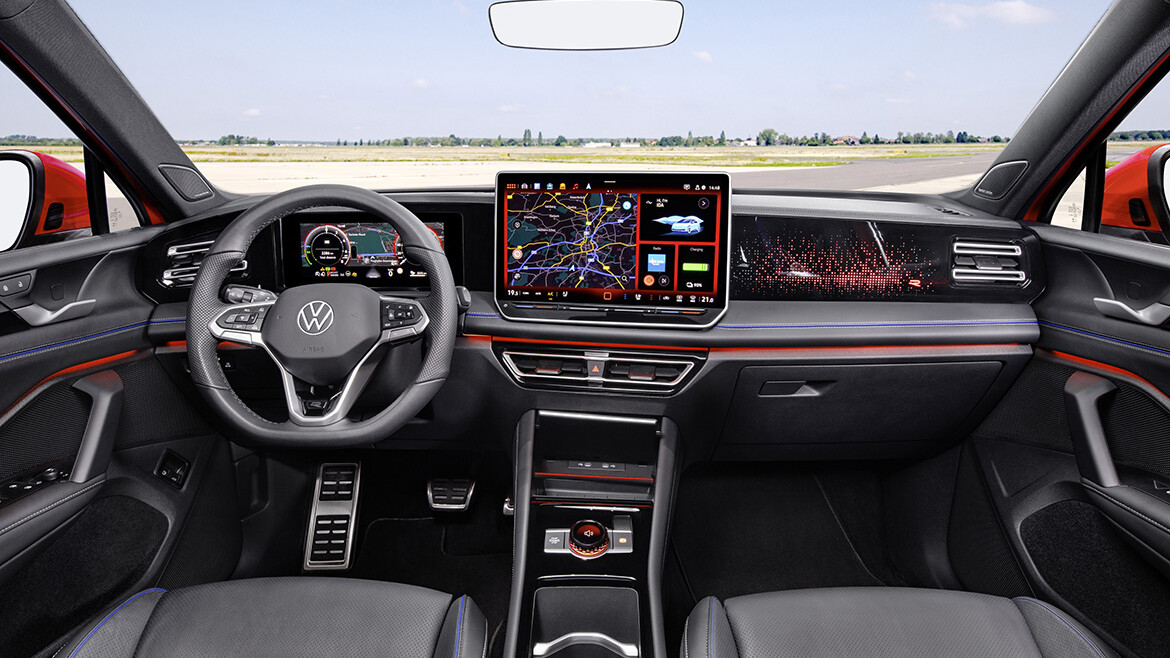
Of course, a Speed Demon story must be grounded in context. The Tiguan is a product of its market and its mission: to be usable, safe, comfortable and versatile. Its interior reflects that ethos. The driving position is confidently upright, the view over the bonnet good for assessing corner entries at speed, and the ergonomics are familiar Volkswagen — logical, button-light where needed, and designed for rapid comprehension even when you're in the zone. Materials and build quality in the 2023 model continued Volkswagen's trend toward solid finishes; the cabin is durable, which matters when you subject a car to the repetitive stresses of track work one day and family duties the next. The infotainment systems, driver displays and steering-wheel controls are arranged so that you can digest information quickly between corners — an underrated advantage when you're trying to stay focused on apexes and braking markers.
Historically, the Tiguan has been more of a chameleon than a gladiator. Early models leaned on their Golf-like competence to reassure buyers skeptical of SUVs; later iterations matured into a global workhorse that could be tailored to markets with different priorities. That adaptability is perhaps its greatest legacy. You can spec a Tiguan as a polite commuter, a long-distance cruiser, a family mover, or — with the right combination of AWD and chassis options — a surprisingly brisk machine capable of spirited laps. Volkswagen even extended the line into more performance-branded territories elsewhere in its range, and the Tiguan's evolutionary arc hints at what a performance-orientated compact SUV can be when the brand decides to sharpen the chassis and the powertrain.
From my off-road background, there's also a quiet admiration for how the Tiguan navigates rougher ground. While I didn't take our test car into deep mud or scramble it up rock chutes during this track-focused day, the Tiguan's cleared approach angles, manageable overhangs and optional all-wheel-drive systems make it a credible light off-roader for owners who occasionally stray from tarmac. It's imperfect in that realm — it's not built to be a Land Rover or a dedicated 4x4 — but its competency on unmade tracks enhances its appeal as a do-it-all vehicle. In the context of a busy life that includes weekends away and family adventures, the Tiguan's multi-terrain aptitude is a pragmatic virtue.
After a day of mixed-weather laps I found myself back in the paddock writing notes on the same clipboard I take into off-road tests. The verdict sits in the middle, but it's not neutral: the 2023 Tiguan is a refined, capable compact SUV that tolerates and sometimes rewards sporty driving. It's not a Speed Demon in the pure, horsepower-obsessed sense, but it can be hurried effectively thanks to a competent chassis, communicative steering, consistent brakes and a willing gearbox. Its historical trajectory — from early compact soft-roader to the mature, polished 2023 model — is a study in incremental improvement and intelligent packaging. Volkswagen didn't turn the Tiguan into something it's not; instead it reinforced the car's strengths and, in doing so, made it a surprisingly satisfying companion when you ask it to play faster than its usual station.
For readers thinking about the Tiguan and how it might serve a performance-tinged life, my take is pragmatic. If your goal is outright lap time and a low center of gravity, look elsewhere. But if you want an SUV that will deliver confident, composed performance when required — that will happily ferry the family during the week and accept an afternoon of spirited laps in the country on the weekend — the Tiguan makes a compelling case. Equip it thoughtfully: the right chassis pack, a responsive gearbox and, if available in your market, the AWD system will transform the character from merely competent to engagingly competent. In short, the Tiguan is not the snarling speedster of legend, but in 2023 it's an experienced, versatile companion that can still teach you something about the satisfying balance between everyday practicality and the joy of going fast.
As someone who traces the paths SUVs take from rough roads to family driveways, I see the 2023 Volkswagen Tiguan as a pragmatic milestone in that lineage. It started life on the MQB bones shared with Volkswagen’s hatchbacks, but over successive iterations it grew into a versatile compact SUV that balances everyday usability with the ability to be hurried down a twisty lane or nudged onto a muddy farm track. In historical terms the Tiguan represents Volkswagen’s shift from Golf‑derived crossover experiments to a mainstream, durable SUV that can shoulder family duties and weekend adventures without drama. On the road the Tiguan’s chassis and DSG gearbox reward measured inputs; optioning 4MOTION and adaptive damping sharpens its manners and makes it feel more composed when the tarmac gives way to gravel. It’s not a rock‑crawler or a purpose‑built off‑roader, but its light off‑road competence and sensible packaging make it an honest tool for outdoor life — the kind you take when you want gear, passengers and a bit of rough track in your plans. Build quality and cabin ergonomics speak to Volkswagen’s steady march toward refinement, and over the years the Tiguan has become a vehicle that owners can trust for many miles and varied uses. If you value rugged everyday usefulness, modular practicality and a chassis that will tolerate spirited driving when called upon, the 2023 Tiguan remains a very sensible pick. For purists chasing lap times or a low, nimble hot hatch experience, look elsewhere. For those of us who prize durability, versatility and the ability to go a little further off the beaten path, the Tiguan carries on Volkswagen’s legacy in the compact SUV market with quiet competence.
Specifications
| Specification | Value |
|---|---|
| Model year | 2023 |
| Platform | Volkswagen MQB |
| Body style | Compact SUV (5-door) |
| Seating capacity | 5 |
| Drivetrain options | Front-wheel Drive (standard), Optional 4MOTION All-wheel Drive |
| Transmission | DSG Dual-clutch Automatic |
| Engine types | Turbocharged Petrol And Diesel Options (market Dependent) |
| Suspension | Standard Suspension With Optional Adaptive Damping / Sport Chassis |
| Brakes | Ventilated Front Discs (supports Repeated-use Performance) |
| Interior | Practical Cabin With Familiar Volkswagen Ergonomics And Solid Material Quality |
| Notable features | Driver-assist Systems, Selectable Driving Modes, Practical Packaging For Cargo And Family Use |