
Let’s Go on a Trip: Land Rover Defender 90 — Price & Specs, and Taking the Short Wheelbase Where Others Don’t
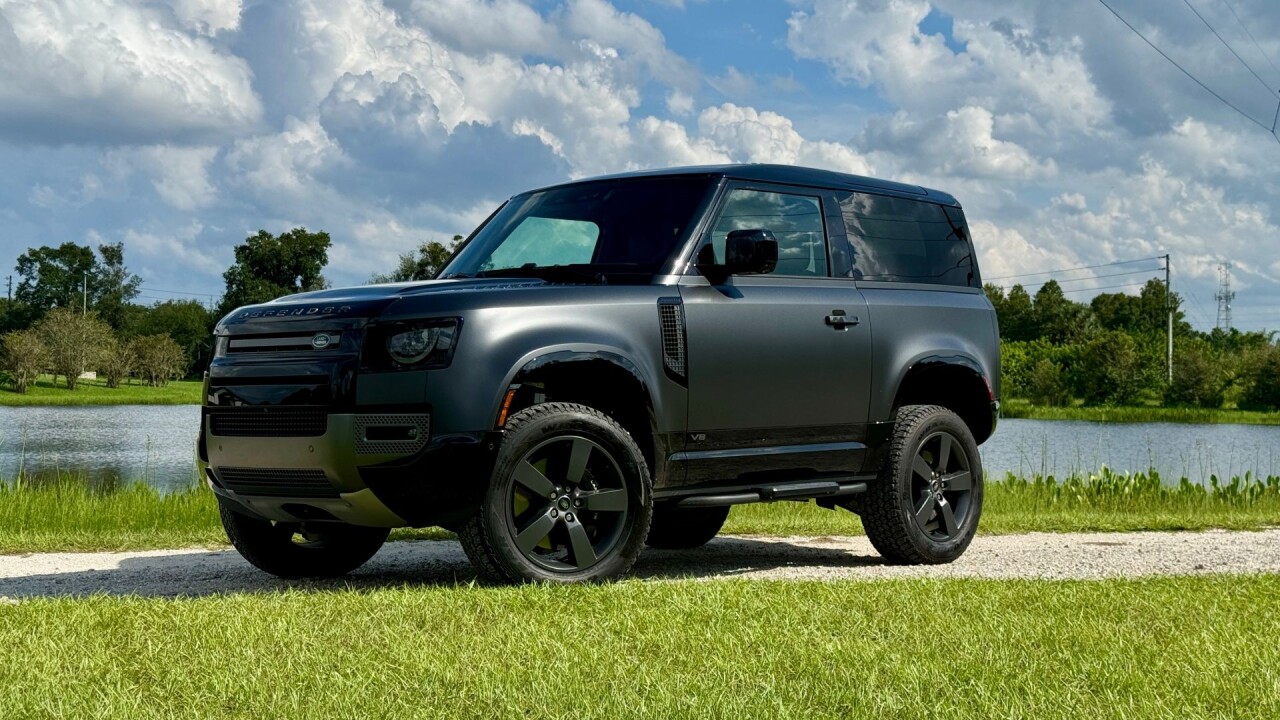

My trip began with an early ferry crossing and a narrow ribbon of coastal road. The Defender 90’s compact footprint — shorter between the axles than its 110 sibling — is immediately noticeable. On tight, twisting lanes where the 110 can feel a touch ponderous, the 90 allows you to thread through tighter switchbacks without constant parking-lot maneuvering. The steering has weight and a degree of precision that belies the vehicle’s bulk. It’s not razor-sharp like a sports car, but it gives clear, linear feedback: turn in, the front end bites predictably, and the short wheelbase helps the rear end follow obediently rather than lagging behind on slower, tighter turns.
Because I’m a creature of habit, I judge the ride and chassis by how much confidence they instill when the surface changes. The Defender 90 rides on a suspension setup that prioritizes robustness and composure over razor-edge response. On the coastal tarmac, it absorbed imperfections without pitching into boatswain rolls, and high-frequency ripples were filtered away neatly. On the wet sections my test route threw at me, the traction control and the brakes combined to deliver a composed, linear feeling under deceleration; the ABS intervention is well judged and progressive rather than grabby, so you can still modulate the stopping effort with a familiar heel-and-toe rhythm if you want to hustle — something I still do on winding roads.
Then we turned onto tracks where the Defender 90 moves from competent road car to specialist. Gravel lanes, rutted farm roads and heather-strewn moorland tracks are where its engineering shows. The 90’s geometry — approach and departure angles, the short rear overhang and its compact wheelbase — transforms it into an extremely capable off-roader. What really matters out there isn’t headline spec or traction control modes; it’s how the car communicates in the slow, technical stuff. The Defender 90 talks to you through its steering, its brakes and the way the chassis settles. It allows you to place each wheel with intention. If you come at a steep, rutted climb you can manipulate the throttle and the balance, feed the wheel, let the suspension load, and trust the available traction rather than being surprised by snap oversteer or a sudden lift-off lurch. For anyone who values control when the surface is indifferent, that’s gold.
I spent a day exploring a section of coastline that required a confidence-inspiring wading sequence and some awkward, rock-strewn descents. The Defender 90’s off-road systems — low-range gearing, differential settings and adjustable traction aids — are intuitive and quick to engage. You don’t need to be an expert to get the most from them: choose the mode, use the brake or throttle inputs deliberately and the car does the rest. It’s not magic; it’s engineering that lets you do what your instincts tell you to do without constantly fighting the electronics.
Practicality is often overlooked when journalists wax lyrical about capability. The Defender 90 is compact, but it’s not claustrophobic. The driving position is high and commanding, with a clear view out in all directions — a genuine advantage off-road and in town. Controls are sensibly placed and robust: things you’ll use when your fingers are cold or muddy. The cargo area in the 90 is admittedly smaller than the longer-wheelbase models, so think carefully about whether you need a roof box or roof-rack setup for longer expeditions. I fitted a modest overland roof-rack and it transformed the car into a storage-efficient camp carrier without upsetting balance excessively, though I’d recommend planning load distribution carefully to keep weight centered and low.
Interior quality has that Land Rover mix of ruggedness and refinement. Materials feel durable where they need to, and there’s a functional, almost utilitarian logic to the layout that I appreciate — especially on a trip where boots and weather take their toll. The infotainment is modern enough for navigation and media and integrates readily with a smartphone. On a more personal note, I appreciated the array of anchor points for kit and the ease with which you can clean the cabin after a muddy day; surfaces don’t require gentle handling, and that’s liberating when you spend as much time outdoors as I did on this trip.
Fuel stops and logistics are part of any good overland schedule. The Defender 90 is not what you’d buy if your sole priority is hyper-efficiency; it’s a heavy, capable car and that will always have consequences. What you’re paying for is the ability to access places and to remain composed when surfaces become uncertain. On my itinerary I encountered long stretches where range and fuel planning mattered, and the Defender handled them as a reliable companion. The convenience of a conventional fueling setup (and, on models with that option, the presence of hybrid variants) makes it adaptable for both remote journeys and daily use.
Handling-wise, the short wheelbase gives the Defender 90 an agility that many SUVs of this size lack. On winding secondary roads I felt less like I was piloting a truck and more like I was driving a compact SUV with serious intent. That doesn’t mean it corners like a sports car: there’s body roll and the mass is always evident, but the roll is controlled. The progressive Nivomat-like compliance through mid-corner bumps and the predictable weight transfer allow you to place the car confidently. For anyone coming from a performance background — that includes me — the joy here is in extracting clean, quick lap-like sections on public roads without unsettling the chassis or your passengers.
Brakes are strong and resistant to fade in normal use, but if you’re towing or driving in mountainous terrain you should pay close attention to heat management and brake technique. The Defender platform is engineered for towing and load-carrying; on my trip I towed a small trailer with camping gear and the car remained composed. Cooling and brake behavior were sensible when I managed pace and downshifted appropriately, which is exactly what you’d expect from a vehicle deriving its DNA from a maker with deep experience in heavy-duty utility cars.
What about value? That’s a complicated question because the Defender 90 is not a commodity; it’s a specialist tool and its value should be judged on capability, durability, and the lifestyle it enables. Compared to similarly capable vehicles, the Defender’s combination of short-wheelbase maneuverability and true off-road prowess makes it a compelling proposition for anyone who will actually use those qualities rather than simply admire them in a car park. Options and accessories add up quickly if you chase the full overland spec, but the car’s baseline competence is strong and it scales well if you invest in racks, recovery gear, and protective equipment.
Reliability on this trip was excellent. No faults, no warning lights, and the build felt tight. Land Rover has invested heavily in making this new Defender robust; that shows in how little fuss it gave me despite being used hard in variable conditions. Maintenance demands will be higher than a compact hatchback, and servicing should be planned, but in real-world touring the Defender 90 earned my trust.
After a week, with muddy boots, a damp tent and a head full of roads and tracks, I parked the Defender 90 and sat there with a gratitude that comes from a job well done. As a former racer I’m hard to please with handling nuance and I still relish a car that gives you the ability to place it precisely. The Defender 90’s mission is different from the racecars I cut my teeth on, but it rewards precise inputs and an understanding hand. It invites you to go to places that matter, to camp places other people haven’t found, and to do so with the confidence of well-engineered systems that back your decisions.
Who is it for? If your life involves adventure, towing, frequent use in poor weather, or the desire to be self-sufficient in places without infrastructure, the Defender 90 is a brilliant choice. If you need maximum interior cargo volume for a family of five on long trips, the longer-wheelbase Defender might suit better. But for a weekend warrior, a coastal photographer, or someone who values maneuverability in the wild, the 90 is a joyful compromise between off-road authority and on-road civility.
In the end, a car is only as good as the roads it lets you take. The Defender 90 did more than move me from A to B; it rewrote where B could be. It’s an honest, capable, and characterful vehicle that’s happiest when the route is adventurous and the weather is uncooperative. For anyone who prizes capability and composure over outright performance numbers, it’s hard not to recommend packing a bag, plotting a route and seeing where a Defender 90 will let you go.
Specifications
| Specification | Value |
|---|---|
| Model | Land Rover Defender 90 |
| Body style | 3-door SUV (short Wheelbase) |
| Drivetrain | Four-wheel Drive (AWD) |
| Transmission | 8-speed Automatic |
| Engine options | Multiple: Turbocharged Petrol 4-cylinder, Turbocharged Diesel, 6-cylinder Mild-hybrid, Plug-in Hybrid Variants (availability Depends On Market And Specification) |
| Fuel types | Petrol, Diesel, Plug-in Hybrid (market Dependent) |
| Seating capacity | Up To 5 |
| Towing capability | Available (varies By Engine And Specification) |
| Off-road features | Low-range Gearing, Differential Control Systems, Selectable Terrain Response Modes |
| Roof options | Available Roof-rack And Overland Accessory Options |