
Thunder Without the Roar: Wrestling the Porsche Taycan (2024) Around a Rain-Soaked Secret Circuit

The We Review Cars track where Porsche and I hashed things out is a narrow, honest circuit: old stone walls, grazing sheep visible over hedges, and a main straight that invites either chastity or wantonness, depending on the state of your soul and the warmth of your tyres. It was in that setting that the Taycan showed its intention: it wants to be fast and it wants you to know it. There is none of the coyness of some modern performance cars — the ones that whisper promises and then hand you a bill for three different adaptive modes. The Taycan delivers, bluntly and brilliantly. Press the loud pedal and the world lurches forward with a composure that would make a surgeon envious. The shove is instant and linear. Unlike an old straight-six that builds momentum like a speech, this is a fistful of instant will. It is both thrilling and vaguely disconcerting: thrilling because you are accelerated in a way that cars with clutches can only dream of, disconcerting because there is no mechanical soundtrack to remind you that you are doing something savage.
I must take off my hat and salute Porsche for the chassis balance. There is a low, planted quality to the car that screams of good engineering rather than toys or marketing departments. The batteries sit low and the car’s mass seems to have been coaxed into behaving like a glued-on ballast rather than a drunken passenger. On the entry to tighter corners, you can feel a rational, considered behaviour: the Taycan does not throw weight around in an emotional crisis. It rearranges it with military precision. That kind of composure is rare, and it means you can push more and feel more — not in the sense of tactile poetry, but in the currency of confidence. This is the currency you want on a narrow, wet circuit when the hedges are lined with unforgiving stone.
Let me be clear. There is a difference between confidence and intimacy. A long-hood, classic Porsche gives you intimacy: a simple governance of mechanics and human will. The Taycan gives you confidence, which in modern motoring terms is not a bad substitute. The steering, for instance, is direct and quick. It lacks the raw weight of an old rack and pinion that makes your forearms work for forgiveness, but it compensates by offering precision at speed. You point it, and the car does what you ask. There is no theatrical drama in the handover; no momentary plea from the steering to reconsider. It is competent, relentless and, when combined with those rewards for committing — the car keeps its composure beautifully — it becomes addictive. You lap, and you lap again.
Braking on a circuit is where modern EVs and classic steel steeds part company in interesting ways. The Taycan blends regenerative and friction braking in a manner that feels, to my surprise, respectful of nuance. In the first few laps I had to learn how to coax the best from the pedals because the initial bite is different from the iron shoes of an older car. But once you adapt, the modularity of the brake pedal becomes an asset: you can scrub speed with a precision that lets you pick an arc with more confidence. This matters on a track where the braking zones are not wide and the exits are the difference between a courteous lap and a proper, lunging one. There is no drama in fade; the Taycan communicates constancy. You do, however, notice the mass on rotation—the car feels heavy when asked to change direction quickly, and that is an inevitable price of batteries. Porsche’s engineers have done a terrific job disguising it, but mass is mass and you can’t entirely escape physics.
Now for the subject that makes some of my friends clutch their pearls: the absence of the internal combustion soundtrack. If you live by the creed that engines are musical instruments, an EV is a silent violin. The Taycan is quiet in a way that is almost rude. But there is a counter-argument, and it is a robust one: silence sharpens everything else. On corner exits you hear tire noise in exquisite detail and the wind plays different notes as you accelerate. When I was pushing hard on that damp day, I became obsessed with mechanical sounds I would previously have ignored — the soft thump of the chassis settling over a kerb, the tiny sighs of the adaptive suspension, the whirring of ancillaries. Silence simultaneously diminishes the theatre and enlarges the stage for subtler cues. For me, that meant a new kind of engagement. Not better than the roar of a flat-six, perhaps, but interesting in its own right. If you are a purist who believes a car is only alive when it coughs and insults you, the Taycan will not convert you. If you can appreciate the art of instantness and the precision that silence facilitates, then the Taycan will become a new sort of ally.
I should, in the interests of honesty, say something about ergonomics and the modern interior that seems to have been designed by people who distrust knobs. The Taycan’s cabin is a study in whatever the contemporary equivalent of restraint is. Smooth surfaces, digital displays and a steering wheel peppered with multifunction buttons — the sort of arrangement that would make a mechanical engineer sigh and a smartphone junkie nod approvingly. There is an occasional frustration when you want a simple, hard switch and find instead a menu buried beneath icons. Yet Porsche has kept the essential feel of the cockpit intact: the driving position is excellent, the controls you actually use most often are arranged sensibly, and the overall ambience — for all its glass and screens — still manages to feel like a Porsche. It retains the posture you expect when you sit in one: a little snug, a little purposeful, and oddly reassuring.
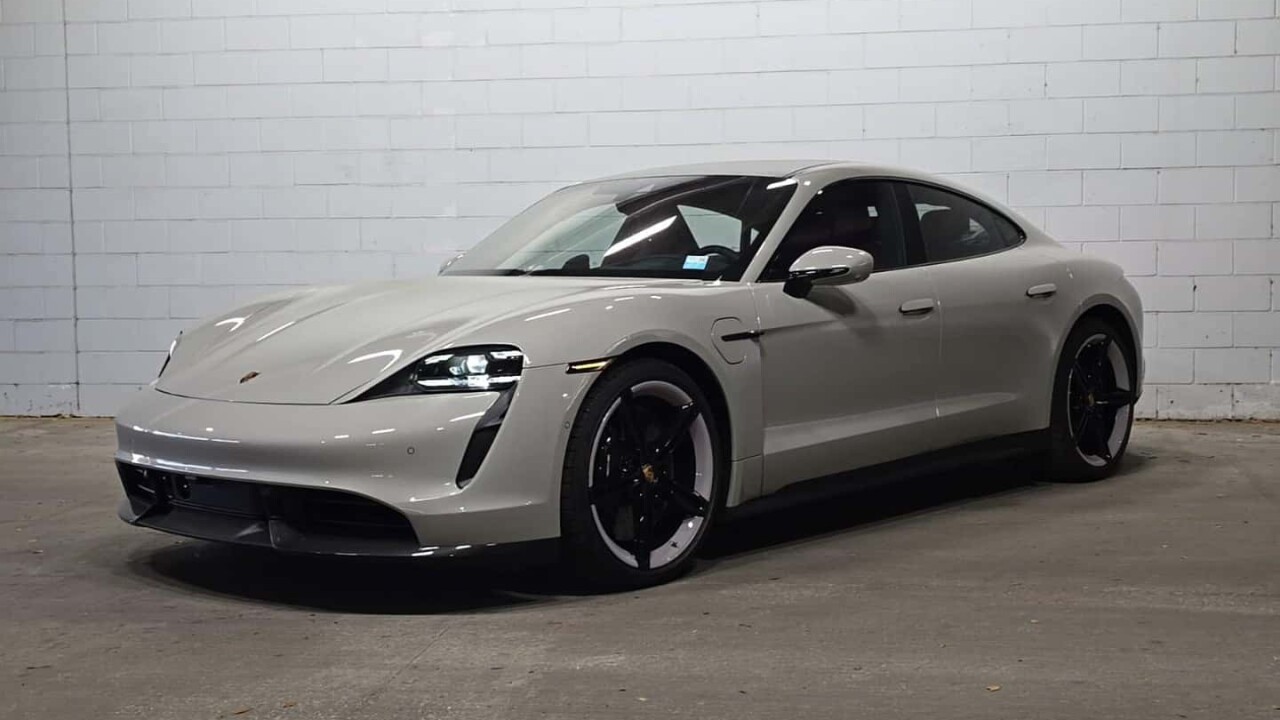
On the subject of personality: the Taycan wears its badge with a wry sort of honesty. It looks like a Porsche because it is a Porsche; the lines speak a family language that stretches back decades. That continuity matters to me as someone who loves classics — there is a thread that connects the old aluminum-bodied sports cars to this sleek electric four-door. You can see it in the way the hips are set, the headlamps' purposeful stare, the lipped rear that seems to insist on being both elegant and functional. It is a modern interpretation, certainly, but it is a tasteful one. Porsche has never been in the business of wild design gestures for their own sake. The Taycan is practical, present and — above all — honest in its intent.
Now, being the contrarian I am (and because I enjoy proding sacred cows with a walking stick), I will confess to moments of petty enjoyment in seeing the establishment get its own medicine. EV evangelists talk about the future as if the past were a moral failure. Yet here is a Porsche, the sort of marque that in previous centuries would have married a boxer engine to a light chassis and some steel out of choice, that instead builds one of the most accomplished electric performance cars I’ve driven. The irony tastes delicious. It is as if the old guard admitted that speed, handling and driver engagement are not exclusively the domain of combustion technology after all. I like being told I was wrong about something by a car that still respects the art of going fast.
Of course, nothing is perfect. On the track, as you push for lap time rather than Instagram likes, you find places where the Taycan is reminded of its mass and electric nature. There is a limit to how fluently it will change direction compared to a featherweight classic; there are subtle moments where its balance calls for different lines and, more importantly, different expectations. The immediacy of torque is a blessing and a temptation: nail the throttle too aggressively mid-corner and the nose can light up with a disconcerting urgency. The electronics are helpful and largely unobtrusive, but they can’t do everything for you. This is not a car that masks the need for driver input; on the contrary, it rewards skillful adaptation. If you squint and imagine that the Taycan is simply another M3 or a hot saloon, you will have missed its point. It is its own beast and expects you to know the dance steps.
When the showers arrived — and they do on that circuit with the annoying regularity of a calendar reminder — the Taycan gained an almost supernatural poise. Where carburetted classics become moody and temperamental, and where modern combustion cars can be noisy in the wet, the Taycan’s predictability shone. It was as if someone had taken a modern, pragmatic view of what a performance car should be: fast, engaging, but fundamentally correct. There is a strong argument to be made that in poor conditions, an electric performance car that distributes its power cleanly and that’s built on a low centre of gravity is more usable — and therefore more fun — than an old-school rear-engined screamer that demands perpetual negotiation.
As a lover of classics, I am inevitably interested in longevity and collectability. I am not going to pretend I can predict the collector market — that would be both arrogant and foolish — but I will say this: the Taycan is a statement. It tells future car lovers that Porsche took electrification seriously and did not compromise the brand’s sporting ethos in the process. Whether that translates to cobbled-together future desirability is another matter. Enthusiasts will always prize smell and sound and the human imperfection that makes old cars loveable. Yet I can imagine a future in which early, iconic electric models — especially those from marques with a storied past like Porsche — acquire a different kind of desirability. We are in the middle of a transition, and the Taycan is one of the clearer, better-executed arrows pointing into whatever comes next.
By the time I stowed the helmet and let the car settle in a cool down lap, I realised the day had also been a modest lesson. I can snarl about touchscreens and nostalgic loss until people stop listening, but that won’t change the fact that a well-engineered machine aimed at performance can still make a classic car lover grin, even if that grin is occasionally tinged with a tear for things that cannot be recreated. The Taycan (2024) is a performance car in the grand tradition: it goes fast, it teaches you to respect it, and it rewards commitment. It does so in a language different to the one I grew up loving, but it is a language of its own that speaks, in surprisingly familiar tones, of balance, speed and restraint.
So, would I buy one? That question is silly in the abstract — what I buy is rarely what the world considers sensible. But as an exercise in modern performance, the Taycan is a triumph and an admission. It admits that electric cars can be thrilling without pretending to be something they are not. It is sharper than many of its contemporaries, more composed than most, and, when you take it out onto a narrow, damp circuit and stop expecting combustion symphonies, it will put a smile on a face that has known too many old Porsches to be easily impressed. I left the track with grease under my nails from a classic car I’d been fixing earlier that morning and with the clean, almost surgical grin induced by a car that is very good at being what it is. That, in the end, is enough for me.
I’ll confess straight away: I turned up to the wet, stone-walled circuit bristling with vintage prejudice and a pocket full of carburettor metaphors. By the time I climbed out of the Taycan I was grinning like a man who’s just been told his favourite pub still sells proper chips. It’s not a combustion symphony — it never pretends to be — but what it is is brilliantly honest about its own virtues: instantaneous, controllable shove, impeccable balance from those low-mounted batteries and steering that tells you exactly what the car is about. The interior is clinical and screen-heavy in a way that will make many of you mutter a few words about lost tactile virtues; I muttered them and then appreciated the driving position that still somehow reads as Porsche. Yes, the weight is there if you hustle it mid-corner, and yes, you will miss an engine note when you want one, but the Taycan’s wet-weather poise and regenerative braking that actually behaves make it frighteningly usable when the heavens open — which, let’s be honest, is most afternoons in this country. As a classic-car lover I’ll never replace a favourite old petrol steed with an electric one for sentiment, but as a performance car the 2024 Taycan earns my grudging admiration: it’s clever, it’s capable and, in its own quiet way, it’s rather irresistible.
Specifications
| Specification | Value |
|---|---|
| Launch year | 2024 |
| Powertrain | Battery-electric |
| Battery placement | Low-mounted Underfloor |
| Torque character | Instantaneous, Linear Delivery |
| Braking | Regenerative And Friction Braking Blend |
| Steering | Electric, Direct And Precise |
| Mass character | Substantial Curb Weight But Well Distributed |
| Interior | Modern, Screen-dominated Cockpit With Classic Porsche Driving Position Cues |
| Design | Porsche Lineage; Evolutionary Styling |
| Wet weather behavior | Predictable And Confidence-inspiring |