
Mercedes‑Benz EQS SUV: An Eco‑Adventure From a Former Racing Driver’s Perspective

From a chassis perspective, the EQS SUV borrows heavily from Mercedes’ electric architecture and active suspension technology. What matters when you’re driving gently for economy or pushing the tempo to reach an efficient cruise speed is how the suspension controls body motion without inducing parasitic energy losses. Mercedes’ adaptive air suspension, combined with active damping and roll control systems available in higher specifications, manages to limit pitch and roll without harshness. That trade‑off is important: stable aerodynamics and minimal suspension movement reduce the extra drag and rolling losses that compound at speed, which is exactly what you want when optimizing for range on an eco route.
Braking and regenerative systems are where the EQS SUV shows its maturity. The regenerative braking is configurable and can be tuned to a strong recuperation mode that allows significant one‑pedal driving, which in practical eco driving reduces hydraulic braking events and recovers energy that would otherwise be lost as heat. Mercedes integrates this smoothly with the hydraulic brake system, so you don’t get the unpleasant bite transitions that lesser systems sometimes produce. For an eco‑adventure that includes frequent descents or stop‑start village driving, that strong, consistent regen profile is a genuine advantage.
Thermal management is a quiet hero in any serious BEV. Batteries, inverters and motors hate extremes; their efficiency curve is narrowest when temperatures are kept in an optimal band. The EQS SUV’s thermal control — which includes cabin heat management strategies and heat pump use where specified — reduces the cold‑weather efficiency penalty compared with a car that has no heat pump or sophisticated battery conditioning. In practice this means less range loss during frosty morning starts, and quicker preconditioning before you plug in for a DC charge, which shortens the time you spend at higher charging power when the battery is already warm and receptive.
Charging behaviour has a direct environmental implication because faster, more efficient charging means less idling at chargers and lower grid losses per mile. The EQS SUV supports AC and DC charging, and its battery management prioritises state‑of‑charge windows that favour fast charging when appropriate while protecting cycle life. On an eco‑adventure route this allows me to plan stops with confidence: top up enough at ‘fast’ stations to get to efficient cruising territory, and then finesse energy use with regenerative braking and steady cruise speeds to minimise further charging time.
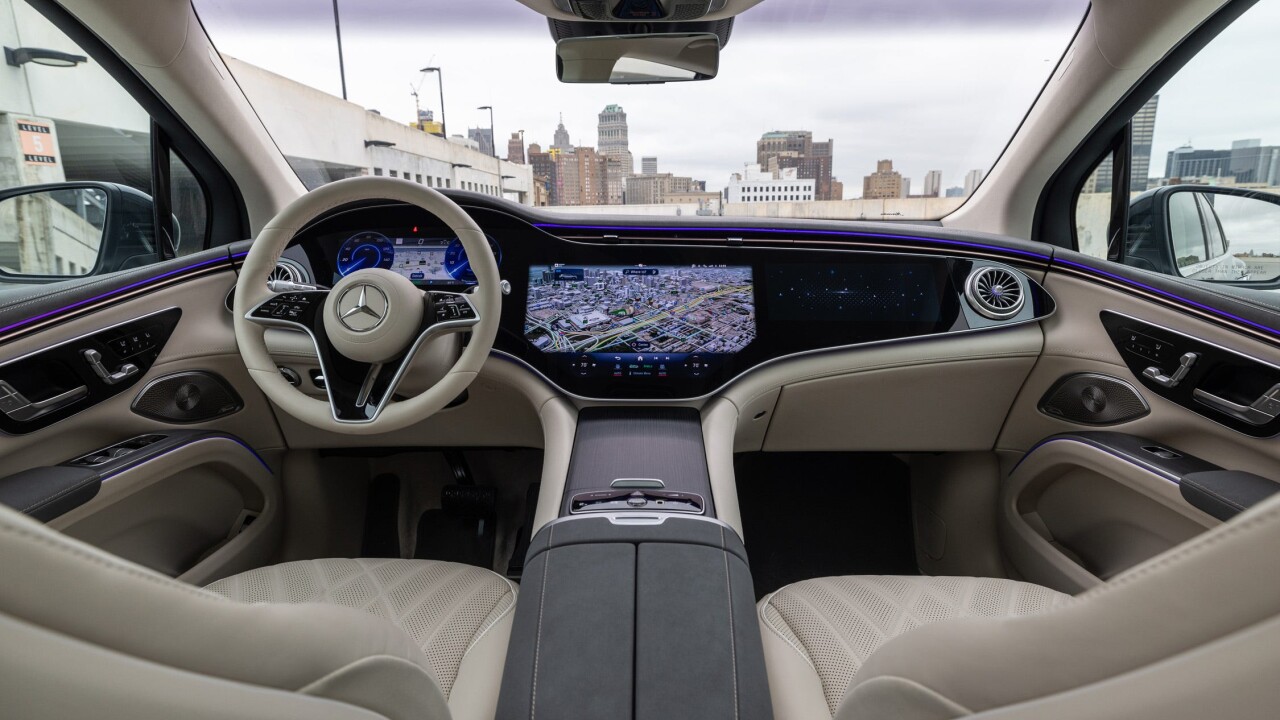
A practical aspect of eco driving that is often overlooked is the interior’s contribution to environmental impact. The EQS SUV’s cabin clearly shows Mercedes’ push for sustainable materials and low cabin energy draw. The seats, electronics and screens are designed for a premium experience but with options for recycled or lower‑impact materials. Equally important is the car’s NVH (noise, vibration and harshness) treatment — less cabin noise means less need to run the audio system at high levels, which in turn reduces electrical load on the battery during long trips.
On handling, I’ll be frank: a full‑size, battery‑heavy SUV will never carve mountain switchbacks like a slim mid‑engine coupe. That said, the EQS SUV surprises with how composed it is. The centre of gravity is relatively low for an SUV — a benefit of the skateboard battery architecture — and the steering calibration aims for a balance between comfort and feedback. In experienced hands, and with the correct tyre and suspension settings, the SUV can be hustled along sweeping rural highways and deliver predictable transitions in roll and weight transfer. The torque delivery is immediate, but Mercedes’ control systems restrain abrupt wheelspin so that progression is linear rather than jerky. For an eco‑adventure where you might want to maintain momentum without triggering inefficient heavy braking or energy sapping acceleration, that linearity is crucial.
Where the EQS SUV stands out in my book is in the integrated approach Mercedes has taken: powertrain, aerodynamics, suspension, thermal management and user interface are aligned to reduce real‑world consumption. The MBUX system and navigation are not just for show — they provide eco routing and charge planning that, when used intelligently, yield tangible benefits on a long trip. I appreciate the level of telemetry Mercedes makes available to the driver; granular consumption readouts, predicted range with and without traffic and elevation considerations, and the ability to precondition the battery en route are all tools that let a driver optimise energy use rather than guessing.
On the topic of environmental impact beyond tailpipe emissions, it’s impossible to ignore the lifecycle perspective. Manufacturing an EV, particularly its battery, carries a material and energy cost. Mercedes has been transparent in reducing lifecycle impacts through recyclable materials and, in some markets, programmes for battery second life and recycling. As a driver, you can reduce your operational footprint by charging from renewable sources where possible and by using the vehicle’s efficiency aids — but the manufacturer’s design choices do matter: the EQS SUV’s use of recycled interior materials and its attention to energy efficiency in auxiliaries are part of a credible sustainability story.
My practical advice for extracting the best eco performance from an EQS SUV on an adventure route draws on a few core principles from my racing days: anticipate, smooth inputs, and manage temperature. Anticipation avoids late braking and heavy acceleration; smoothing throttle and braking inputs reduces energy wasted to tyre slip and brake heat; and managing battery and cabin temperature keeps the drivetrain operating in its most efficient band. Use the car’s regenerative settings to the fullest in rolling countryside, keep a steady, momentum‑preserving speed over crests, and let the navigation plan charging stops that align with natural breaks rather than forcing you into inefficient bursts of speed to make the next charger.
In the end, the EQS SUV is a sophisticated tool for anyone who wants to travel in comfort with a reduced operational footprint, provided you accept the compromises inherent in a large luxury SUV. It is not an ultra‑light efficiency specialist — rather it is a heavy, well engineered EV that manages its weight cleverly and offers systems that work coherently to limit energy loss. For eco‑adventures that mix long highway legs with technical, energy‑conscious driving through varying topography, it is both a civilised companion and, surprisingly, a tractable machine when asked to be driven with purpose. For someone like me, who spent years shaving tenths and then learning to value conservation of momentum, the EQS SUV is a car that rewards thoughtful driving and visibly reduces the cost—both energy‑wise and environmental—of covering long distances.
Finally, as a former racer who walked away from a severe accident at Spa, I bring a particular sensitivity to safety and control. The EQS SUV’s active safety systems, structural integrity and electronic stability tools are integral to its eco profile: keeping you on line and preventing incidents is an efficient practice in itself. Fewer incidents mean fewer repair cycles and lower lifecycle impact. Viewed holistically, Mercedes has created an SUV that merges luxury and technology with a believable environmental story; it’s up to the driver to use the tools and drive with patience to realise the full potential of that package on an eco‑adventure.
Specifications
| Specification | Value |
|---|---|
| Manufacturer | Mercedes-Benz |
| Model | EQS SUV |
| Vehicle type | Luxury Battery-electric SUV (BEV) |
| Powertrain | Electric |
| Battery chemistry | Lithium-ion |
| Drivetrain options | Rear-wheel Drive Or All-wheel Drive (depending On Trim) |
| Platform | Mercedes Electric Vehicle Architecture (EVA) |
| Seating | Five Standard; Optional Third Row Available In Some Markets |
| Charging | AC Charging And DC Fast Charging Capable |
| Regenerative braking | Selectable Regenerative Braking With Strong One-pedal Capability |
| Suspension | Adaptive Air Suspension With Active Damping And Available Active Roll Control |
| Infotainment | MBUX With Available Large Integrated Display Package (Hyperscreen Option Where Available) |
| Release year | Introduced 2022 |
| Power management | Integrated Thermal Management And Battery Conditioning To Optimise Efficiency |