
Silk and Silicon: A Technical Retrospective of the Mercedes‑Benz EQS (2023)
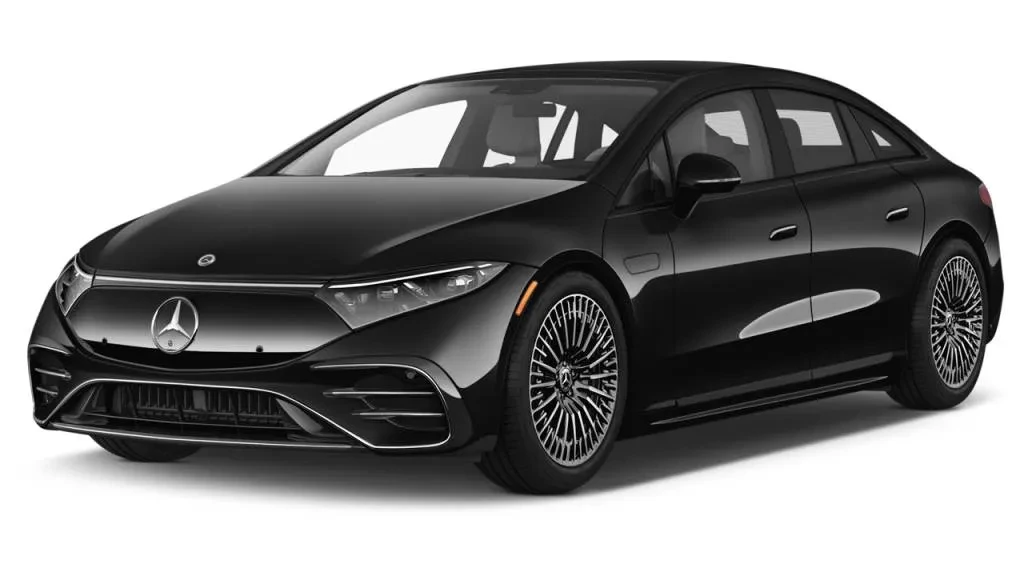

I want to start with the bones: the EQS rides on Mercedes’ EVA (Electric Vehicle Architecture). This is a purpose‑built EV platform rather than a conversion of an ICE chassis, and that matters. EVA is designed to optimize battery packaging, create a low center of gravity and free up interior space, and it also allows the engineers to chase one of the EQS’s headline achievements — very low aerodynamic drag. The EQS achieved a drag coefficient that Mercedes published as class‑leading; it’s a number Mercedes used in marketing because it directly translates to range efficiency at highway speeds. The long, smooth profile, flush door handles, aero wheel designs and underbody panels all serve that single objective: reduce air resistance to extend range and improve refinement.
Under that aerodynamic skin lives the battery pack. Mercedes packaged a large, flat battery pack beneath the cabin floor, prioritizing energy capacity and a low center of gravity. For the 2023 lineup Mercedes offered both single‑motor rear‑drive and dual‑motor all‑wheel‑drive variants — commonly referred to by model names such as 450+ and 580 4MATIC. The layout is familiar to anyone who follows EVs: a high‑voltage traction battery feeding one or two electric drive units with compact power electronics. That arrangement gives the EQS the flexibility to trade range for performance depending on the chosen drivetrain. Mercedes also engineered a suite of thermal and battery management systems to keep the chemistry operating efficiently across a wide range of conditions; that’s a significant part of how Mercedes manages to extract credible real‑world range while also preserving long‑term battery health.
Where Mercedes put a lot of development energy was in the seamless integration of hardware and software. The EQS was one of Mercedes’ first cars to fully embrace the MBUX software strategy at scale, and the Hyperscreen — a sweeping glass instrument panel that marries driver display, center screen and passenger display into one continuous surface — became the poster child for that approach. I find the Hyperscreen fascinating from an engineering standpoint because it’s more than flamboyance: it consolidates sensor and UI elements, enables over‑the‑air updates, and demonstrates Mercedes’ willingness to reimagine the driver interface for an era where vehicles are part hardware and part software platform. The result is a cabin that feels like a living system rather than a collection of buttons.
Chassis engineering in the EQS shows Mercedes balancing contradictory demands: a soft, floating ride befitting a flagship saloon, and the stability and composure expected at higher speeds. Air suspension is standard or widely available depending on market and trim, allowing the car to maintain ride height and composure while damping transitions with a courtesy that feels almost surgical. For turn‑in and agility, Mercedes equipped the EQS with rear‑axle steering on many variants, tightening the turning circle and improving agility at low speeds while reducing the trade‑off between long‑wheelbase stability and downtown maneuverability. The electronic control systems that govern these subsystems — active damping, steering ratio adjustments and the rear‑wheel steering logic — show how electronic actuation permits a broader performance envelope in a single vehicle package.
I’m deliberately not writing this as a spec sheet because the EQS is as much about the way systems work together as about headline numbers. Having said that, some performance metrics are worth noting because they shape the driving experience. The single‑motor rear‑drive EQS is focused on optimizing range and refinement, while the dual‑motor 4MATIC variants emphasize traction and brisk acceleration. What you feel in either setup is immediate electric torque, silent operation at speed, and a chassis that isolates harshness while remaining communicative enough for the driver to feel confident. Mercedes engineers tuned regenerative braking to be intuitive, allowing for smooth energy recuperation without the abruptness some EV setups produce, and the brake blending — transitioning from regen to hydraulic brakes — is calibrated to be unobtrusive.
One of the EQS’s most striking engineering achievements is how Mercedes managed to reconcile that low drag profile with crash safety, NVH control and thermal management. A very slippery body can be a packaging challenge: it demands careful attention to where heat exchangers are located, how airflow is channeled to battery and motor cooling systems, and how underbody protections are implemented without disturbing aero. Mercedes’ solution uses coordinated active elements and careful internal ducting so that cooling needs don’t compromise the exterior profile. From an engineering perspective, that’s a mature blend of thermal science and aero design; you don’t usually see that level of integration in one package unless the manufacturer has committed to an EV‑first architecture.
As someone who comes from an off‑road background, I always evaluate how robust a car feels when pushed into environments it’s not necessarily designed for. The EQS is not an off‑roader — ground clearance is modest and body protection is oriented to road hazards rather than rocks — but its structure and suspension systems are engineered for durability. The high‑voltage system is securely packaged and isolated, traction control and stability systems are capable and behaviorally predictable, and the AWD variants can handle slippery surfaces with confidence. If you’re after a luxury cruiser to ferry you through mixed‑surface country lanes and wet coastal roads, the EQS is a capable companion. Expect it to politely refuse dirt‑track humiliation rather than to overcome it; that’s by design.
Charging architecture is another area where the EQS signals Mercedes’ intent to compete in the modern EV landscape. The car supports AC and DC charging; Mercedes equipped it to work with public fast‑charging networks and home charging solutions, and the company tuned the charging curves to balance peak rate with battery longevity. In practice this means you can travel long distances with reasonable charging stops and expect the battery management system to modulate charge to avoid unnecessary degradation. The combination of a large battery pack, efficient aero and refined powertrain makes the EQS a car that rewards disciplined driving with large real‑world mileages between charges.
Inside, the EQS continues Mercedes’ tradition of combining material quality with technical polish. The cabin is quiet by design — sound deadening, aerodynamic smoothing and electric propulsion all conspire to make the interior an oasis. Fit and finish are, as you’d expect at this price tier, excellent. Materials range from traditional leathers and woods to modern sustainable options, reflecting Mercedes’ dual aim of luxury and environmental awareness. The seating geometry and ergonomics show the company’s long experience with flagship saloons: long‑legged passengers are well accommodated, and controls fall naturally under hand. The Hyperscreen’s integration does present a philosophical shift; systems that were once physical are now digital, which has implications for long‑term usability and ownership. Mercedes tackles that with a generally logical software layout and the promise of updates, but the reliance on software does change the maintenance calculus compared to older mechanical systems.
From a safety and driver assistance perspective, the EQS was designed to showcase Mercedes’ latest suites. A range of sensors — cameras, radar and ultrasonic devices — supports advanced driver assistance features such as adaptive cruise, lane keep assist and steering assistance in certain conditions. That integration follows the historical trajectory of Mercedes turning luxury into a technical showcase; every successive S‑Class generation introduced new active safety features and the EQS carries that torch into the electric age. The distinction here is the tighter coupling of sensors to powertrain and chassis control, which allows the vehicle to react holistically to hazards rather than as isolated subsystems.
Longevity and ownership are practical questions I always ask. The EQS’s electrical architecture is well packaged to minimize exposure to environmental threats, and the battery pack sits within a robust structural cradle. Serviceability reflects Mercedes’ global dealer network and the company’s shift toward modular electrified components; some systems are designed for straightforward replacement or recalibration. Ownership also brings software considerations — the car benefits from feature updates and map updates delivered over the air, which can add capabilities post‑delivery. That’s a double‑edged sword: you get improvements without visiting a dealer, but you also become more dependent on Mercedes’ software lifecycle for long‑term feature availability.
Technically, what struck me most as I revisited the EQS is the degree to which Mercedes treated this car as a platform for systems engineering rather than merely a new drivetrain. The company applied decades of S‑Class lessons — NVH control, occupant comfort, safety system integration — to an architecture that demands new thinking about packaging, software and energy management. The result is a car that doesn’t feel like a retrofit but as a reimagined flagship where electric propulsion amplifies the qualities Mercedes has long prized: silence, isolation from the outside world, and a feeling of effortless motion.
That said, the EQS also illustrates limits of paradigm shifts. Its aero‑first shape and low ride height are compromises that favor efficiency over every‑terrain capability. If you’re in my world, where knobbly tires, long travel suspension and a chunky skid plate are badges of honor, the EQS feels like the opposite extreme — supreme on tarmac, vulnerable off it. But judged on its brief, the EQS succeeds. It’s a highly mature luxury EV that pushes the boundaries of what a saloon can be when the combustion engine is removed from the equation.
Looking back at Mercedes’ historical arc, the EQS reads like a natural next chapter. The company that once pioneered safety cages, air suspension and luxury innovations has repurposed those competencies for the EV era. The EQS is less about revolution for its own sake and more about evolution: translate the S‑Class’s best traits into an electric package, improve efficiency with aero and software, and present a digitally enabled interior that anticipates future connectivity. For buyers and engineers alike, the EQS became a statement that Mercedes’ flagship values would survive electrification — and in many respects, be enhanced by it.
From an off‑road adventurer’s perspective, I don’t pretend the EQS is a partner for the unbeaten track, but I respect it for what it does best: long, silent miles with a sense of confidence and control. Technically, it’s a showcase of integrated systems engineering — battery and thermal management, aero optimization, advanced chassis control and a software‑first interior — and as a 2023 model it represented Mercedes’ serious commitment to electrification without losing the brand’s DNA. For anyone tracking how legacy luxury brands migrate into the EV world, the EQS is an instructive case study: conservative in brand expression, ambitious in technical integration, and very deliberate in the trade‑offs it makes. I’ve always loved trucks for their simplicity and mechanical directness, but I came away from the EQS impressed by the cleanliness of its engineering and the clarity of its purpose.
In closing, the EQS (2023) is a milestone because it shows how far Mercedes could push integration and refinement when freed from the constraints of an internal combustion powertrain. It’s a reminder that automotive progress isn’t only about new propulsion; it’s about rethinking packaging, control logic and user experience. For those of us who judge cars by how well their systems work together — and for whom durability and confidence are part of the measurement — the EQS is an elegant, technically sophisticated statement in the march toward electric mobility.
As someone who cut his teeth testing trucks and SUVs on rough tracks and forest roads, writing a retrospective on the Mercedes‑Benz EQS (2023) has been a study in contrasts. Historically, Mercedes has taken its S‑Class lessons—silence, isolation, structural refinement—and repackaged them for an EV world; the EQS is that translation in full view. It sits on the purpose‑built EVA platform, tucks a large, flat battery under the floor and dresses itself in aero‑first bodywork and the now‑iconic Hyperscreen, all of which point to a brand evolving its flagship values rather than abandoning them. From a systems‑engineering perspective the car is mature: coordinated aero and cooling, refined regenerative braking and air suspension with active damping deliver the kind of on‑road composure you expect from a Mercedes flagship. That very maturity, however, is also its defining limitation for someone like me. The low ride height, aero packaging and luxury‑first tuning mean the EQS is emphatically an on‑road palace, not an off‑road tool. It is durable and serviceable within its design envelope and benefits from modular electrified components and OTA software refinement, but it was never intended to be taken beyond sealed roads. Looking back, the EQS (2023) is an important historical waypoint — a deliberate, conservative and technically integrated flagship that marks Mercedes’ careful migration into electrification. I admire its engineering and the fidelity to flagship comfort, even as I rue the lost opportunity to marry that grandeur to genuine ruggedness.
Specifications
| Specification | Value |
|---|---|
| Platform | Mercedes EVA (Electric Vehicle Architecture) |
| Drivetrain | Available As Single‑motor Rear‑drive (range‑oriented) And Dual‑motor 4MATIC (performance/traction‑oriented) |
| Battery pack | Large, Flat Battery Mounted Beneath The Cabin Floor (underfloor Packaging) |
| Charging | Supports AC Charging And DC Fast Charging |
| Suspension | Air Suspension With Active Damping |
| Rear axle steering | Available On Many Variants |
| Aerodynamics | Low Drag Coefficient Aided By Long Smooth Profile, Flush Door Handles, Aero Wheels And Underbody Panels |
| Thermal management | Coordinated Cooling Ducting And Active Elements Integrated With Aero And Safety Requirements |
| Regenerative braking | Tuned For Smooth, Intuitive Behavior And Unobtrusive Brake Blending |
| Interior technology | MBUX Software With Hyperscreen (integrated Instrument/centre/passenger Displays), OTA Update Capability |
| Nvh | High NVH Isolation And Premium Material Finishes |
| Body style | Full‑size Luxury Saloon |
| Safety and assistance | Advanced Driver Assistance Suite Using Cameras, Radar And Ultrasonics With Integrated Vehicle Controls |
| Serviceability | Modular Electrified Components And Mercedes Dealer Network Support |
| Intended use | Designed Primarily For On‑road Luxury Cruising And Long‑distance Efficiency |
| Off road capability | Limited — Low Ride Height And Aero Packaging Compromise Off‑road Use |