
Between Elegance and Utility: My Long Take on the 2023 Mercedes‑Benz GLC
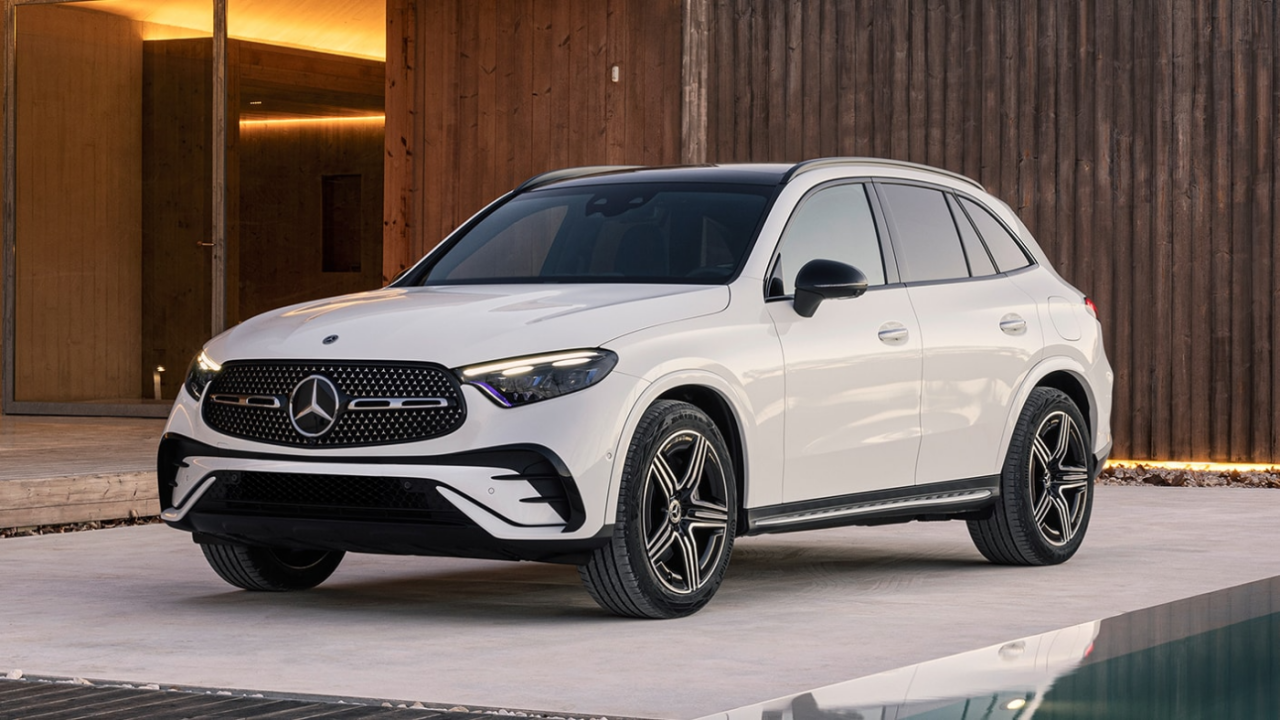

I’ll begin with the mechanical heart most buyers will interact with: the widely available 2.0‑litre turbocharged four‑cylinder. In the U.S. market this engine is the basis for the GLC 300; it is paired with Mercedes’s well‑known 9G‑TRONIC nine‑speed automatic gearbox and can be specified with the 4MATIC all‑wheel‑drive system. The engine is compact, light relative to older V6 units, and tuned to deliver tractable torque across the midrange. That combination — a potent, efficient four‑cylinder and a long‑ratio nine‑speed — is emblematic of Mercedes’ approach to the class: extract refinement and usable performance while managing emissions and fuel economy. On the technical side, the 9G‑TRONIC continues to impress in its ability to keep revs low at cruise and to deploy ratios smoothly under load; it’s a transmission that helps mask the GLC’s weight, something I’m always mindful of when comparing modern SUVs with lighter, older sports saloons.
Underpinning the GLC is Mercedes’ modular sedan architecture lineage shared with its C‑Class family: a unibody structure that uses a mix of high‑strength steels and aluminum elements to balance stiffness and mass. The suspension package is conventional by modern standards — independent front and multi‑link rear geometry — but what changes the character is the availability of adaptive damping and Mercedes’ AIRMATIC air suspension on certain trims. AIRMATIC provides a clear advantage in a vehicle designed to ferry passengers in comfort: it smooths undulations and can be tuned for different ride heights or firmness settings. For those after sharper responses, the tuning of steering and dampers can lend surprisingly composed handling for a vehicle of this size and center of gravity. That said, the GLC is never intended to feel like a compact saloon lowered on cones; it maintains a measured, controlled poise that prioritizes composure over fanaticism.
The 2023 update folded into the GLC line some notable technology upgrades that will matter to owners and future collectors alike. Mercedes’ MBUX infotainment architecture now sits front and center — a dual‑screen layout with configurable displays, voice recognition that actually listens when you say “Hey Mercedes,” and a suite of connectivity services. The system is tactile, fast, and better integrated than the earlier units on older Mercs. Apple CarPlay and Android Auto compatibility give pragmatic utility, while optional Burmester audio systems underline Mercedes’ attention to aural quality. From a technical viewpoint, the GLC’s electrical architecture is no longer a simple 12V affair in many trims: 48V mild‑hybrid elements are present to supply auxiliary power, smooth start‑stop transitions, and help with momentary torque fills. These systems improve real‑world drivability but incrementally complicate maintenance and eventual restoration — a fact I don’t take lightly when thinking about long‑term ownership and collectability.
Safety and driver assistance are extensive on the 2023 GLC. Mercedes offers a full complement of active systems: adaptive cruise control with steering assist, lane‑keeping and lane‑change assist features, automated emergency braking, and sophisticated camera and radar fusion that keeps the vehicle aware of its surroundings. These technologies are impressive in everyday driving; they reduce fatigue and act as a safety net in ways that older cars could only dream of. However, the proliferation of sensors, camera arrays, and semi‑autonomous logic presents a potential stumbling block for future restorers — electronics age, software becomes obsolete, and proprietary modules can be difficult to recalibrate decades down the line. From the perspective of a preservationist, that represents both brilliance and brittleness: brilliant for safety now, brittle in terms of long‑term mechanical purity.
Performance extends beyond the base model. Mercedes offers AMG variants for customers demanding more dynamism: the AMG‑badged GLCs sharpen chassis, add uprated brakes, and fit engines that lift the GLC’s personality into the performance SUV territory. These AMG models are significant because they show the platform’s flexibility and the brand’s engineering depth. They also influence how the entire model range is perceived in the market, as the presence of performance siblings often elevates the desirability and perceived sporting credibility of standard models. For the collector in me, that interplay — between the everyday luxury of the GLC 300 and the full‑throttle intent of AMG models — is fascinating. It mirrors the classic world where base models and sporting variants create a tapestry of desirability decades later.
On the subject of materials and interior craft, Mercedes has done something subtle but important: the 2023 GLC’s cabin is restrained luxury rather than flamboyant opulence. Soft‑touch plastics, genuine metal or wood trim options, and well‑bolstered seats contribute to a sense of quality. Fit and finish are typically Mercedes— precise panel gaps, confident tactile switches, and the kind of switchgear that feels engineered rather than styled. From a collector’s viewpoint, the restraint works in the GLC’s favor. Cars that age gracefully often do so because they eschew ephemeral trends in favor of proportion and ergonomics. The GLC’s interior will not embarrass itself a decade hence, provided the materials age as well as they appear. Leather choices, trim selections, and optional packages will determine how individual cars will stand out to future enthusiasts.
Fueling the modern GLC are more than just combustion engines. Mercedes has embraced electrification across its lineup, and the GLC is represented in that transition in several markets by plug‑in hybrid derivatives and electrified powertrains. These variants marry combustion engines with electric motors and batteries to offer electric‑only driving for short ranges and improved combined efficiency. Technically, PHEV systems add complexity — battery management, high‑voltage safety, regenerative braking calibration — but they also represent a bridge technology that many buyers will appreciate. As someone who loves older mechanical purity, I am ambivalent: these systems reduce emissions and deliver instant torque, but they also represent a new set of components that must be understood and maintained by future caretakers.
Braking systems on the 2023 GLC are conventional all‑disc setups with electronic assist and robustness suitable for a vehicle in this class. Advanced models add larger rotors and multi‑piston calipers, particularly on AMG packages, while regenerative strategies on hybrid variants alter pedal feel and energy recovery. Mercedes’ engineers have done a solid job tuning the braking system for predictability, which is essential in a heavier crossover. Maintenance and longevity of these systems are typically good if factory service intervals are respected— another nod to the practical ownership side of Mercedes‑Benz cars that collectors sometimes undervalue.
Turning to practicality, the GLC is a successful packaging exercise. Rear space accommodates adults comfortably for shorter journeys and the cargo area swallows everyday needs easily. The hatch geometry and low loading lip make it useful for everything from groceries to small furniture. Practicality matters because a car that is useful is more likely to be preserved and cared for. I look at the GLC and see a car that owners will live with and therefore maintain — an important criterion for any vehicle’s future collectability.
Of course, not everything about modern SUVs charms the old‑school enthusiast. Weight is a perennial issue: modern safety, comfort, and emissions equipment add mass, and the GLC is no exception. This weight softens some dynamic edges and changes the sensory feedback between driver and road. Yet Mercedes’ chassis engineers have mitigated much of that by balancing suspension compliance with firm control, so the GLC feels composed in a manner that suits its role. Another tension is the breadth of options: a GLC can be specced into near‑limousine luxury or trimmed down to something more utilitarian. For collectors, the middle ground — well‑specified but not overloaded with extraneous options — often ages best.
I am often asked whether cars like the GLC can become desirable classics. My answer is nuanced. Classic status is rarely granted for everyday vehicles immediately; it is a function of rarity, historical significance, aesthetic appeal, and a story that connects the car to an era. The GLC’s claim to future attention will likely rest on a few axes: first, its role in the transition to electrification within Mercedes’ SUV lineup; second, the existence of high‑performance AMG variants that push the platform’s capabilities; and third, specific limited or special editions that capture imagination. The majority of standard GLCs will be valued for reliability and utility rather than as museum pieces. That said, an AMG‑equipped GLC in an evocative colour with low miles and full history may well be a sought‑after example down the line.
Maintenance and ownership realities are pragmatic considerations I never ignore. Mercedes‑Benz builds to high standards, but complexity increases the importance of correct servicing. Electronic systems, hybrid high‑voltage architectures, and advanced driver aids require specialized diagnostics and software updates. Long‑term ownership will be easiest for cars with documented service histories and owners who follow prescribed maintenance intervals. For enthusiasts who enjoy wrenching, the GLC is less friendly than older mechanical cars precisely because software and modular electronics now play a larger role than mechanical access.
Finally, as an editorialist and a traditionalist, I can’t help but reflect on the broader industry currents that the 2023 GLC represents. Automakers are asked to reconcile legacy craftsmanship with contemporary expectations of connectivity, safety, and emissions. The GLC is a pragmatic answer to that brief: it preserves Mercedes’ core values of luxury and refinement while integrating the technologies that modern buyers demand. Whether that balance will be viewed nostalgically or clinically by future generations depends on how these cars age both in materials and in the relevance of their systems. For now, the GLC rewards sensible ownership with genuine comfort, refined engineering, and a design that is neither shouty nor forgettable.
In closing, my affection for classic cars conditions my critique: I admire a car that is honest in purpose and honest in execution. The 2023 Mercedes‑Benz GLC may not be a classic in the way a low‑production roadster is, but it is a well‑crafted compact luxury SUV that reflects its era with competence. Its technical package — the turbocharged four‑cylinder, the nine‑speed automatic, 4MATIC all‑wheel drive, adaptive damping and available air suspension, MBUX infotainment, and an array of driver aids — embodies modern automotive evolution. For the buyer who prizes comfort, build quality, and a degree of technical sophistication without flamboyance, the GLC is compelling. For the collector who wonders what will be cherished in decades to come, there are reasons to watch the GLC’s evolution closely: the choices Mercedes makes today about electrification, material quality, and performance variants will determine which GLCs, if any, become the cherished survivors of tomorrow.
I’ve always loved cars that wear their engineering on their sleeve and age with dignity; the 2023 Mercedes‑Benz GLC is not that kind of romantic holdout, but it is a very competent, modern compact luxury SUV that deserves respect. In my view the GLC is Mercedes doing what it does best: packaging refinement, safety and technology into a quietly authoritative daily companion rather than chasing ephemeral styling or analogue purity. That pragmatism will please owners who use their cars, and it will frustrate purists who crave mechanical simplicity. As a classic‑car lover I’m wary of the proliferation of 48V systems, high‑voltage hybrids and closed electronic ecosystems — they make today’s cars brilliant to drive and dreadful to resurrect without dealer tools in decades to come. For that reason I’d advise prospective buyers to favour well‑specified but not over‑optioned examples, keep meticulous service records and, if you want something with long‑term collector appeal, consider the AMG or limited/unique derivatives that may later stand out. The GLC won’t set hearts racing in concours halls, but it is a thoughtful, usable machine that represents the present‑day Mercedes ethos — and that, in its own way, is historically interesting.
Specifications
| Specification | Value |
|---|---|
| Engine | 2.0‑litre Turbocharged Four‑cylinder (base GLC 300 Configuration Referenced) |
| Transmission | 9G‑TRONIC Nine‑speed Automatic |
| Drivetrain | Rear‑wheel‑based Architecture With 4MATIC All‑wheel‑drive Available |
| Body type | Compact Luxury SUV (unibody) |
| Platform | Modular Mercedes Architecture Related To The C‑Class |
| Front suspension | Independent Front Suspension |
| Rear suspension | Multi‑link Rear Suspension |
| Optional suspension | Adaptive Damping And AIRMATIC Air Suspension Available On Some Trims |
| Mild hybrid | 48V Mild‑hybrid System Used On Many Trims For Torque‑fill And Start‑stop Refinement |
| Plug in hybrid | Plug‑in Hybrid Variants Available In Some Markets |
| Infotainment | MBUX Dual‑screen Infotainment With Voice Control, Apple CarPlay And Android Auto Integration |
| Driver assistance | Advanced Active Safety Suite Including Adaptive Cruise With Steering Assist, Lane‑keeping Aids And Automatic Emergency Braking |
| Performance variants | AMG Models Available With Upgraded Chassis, Brakes And Engines |
| Construction | High‑strength Steels And Aluminium Mix For Stiffness And Mass Balance |